REVIEW · MAUI
Haleakala Volcano Slingshot Tour from Lahaina
Book on Viator →Operated by Aloha Motorsports · Bookable on Viator
Open-air driving up Haleakalā is a real reset. This private Polaris Slingshot tour takes you from Kaanapali toward Maui’s highest grounds, with a pre-programmed route and time at standout places along the way. I love the freedom of a 24-hour rental, not a rushed bus schedule, and I also like how the stops are planned so you can mix big viewpoints with calmer upcountry breaks.
The main trade-off is the vehicle is open, so weather hits fast. You’re exposed to sun, wind, and rain, and you’ll feel it at sea level and again at the summit. Also, the onboard GPS is helpful, but you may still want a backup navigation app for the occasional annoying turn.
In This Review
- Key things that make this tour worth your time
- Why a Slingshot up Haleakalā feels different than a bus tour
- Price and what you really get: $541 for 2 plus park fees
- Before you go: sun, wind, and cold hit hard at Haleakalā height
- Driving setup that makes or breaks your day
- The route in motion: from Kaanapali up to the summit zone
- Stop 1: Haleakalā Visitor Center at 9,740 feet
- Stop 2: Haleakalā Crater—what you’re looking at is erosion, not fireworks
- Stop 3: Haleakalā Observatory and those wide-open 360-degree views
- Stop 4: Kula Botanical Garden—cooler air and easy wandering
- Stop 5: Ali’i Kula Lavender—rows of purple and sweeping valley views
- Stop 6: MauiWine—pineapple-forward flavors and classic estate style
- Stop 7: Worcester Glassworks—hand-blown art you can watch happen
- Stop 8: Maui Tropical Plantation—tram tour and farm-to-table at the Mill House
- Who should book this (and who should rethink it)
- Should you book the Haleakalā Slingshot tour from Lahaina?
- FAQ
- What’s included with the Slingshot rental?
- Are park entrance fees included?
- Do I need a reservation for sunrise?
- How long is the tour?
- Where do I start and end?
- What do I need to drive?
- Can I cancel and get a refund?
Key things that make this tour worth your time

- 24-hour Polaris Slingshot use means you control the pace, not the clock
- Pre-programmed route in the onboard navigation helps you hit the right stops without planning every turn
- 360-degree summit-style views are a big part of what you’re buying here
- Open-air driving forces good weather prep (sun protection and layers matter)
- A balanced itinerary mixes volcano sights with gardens, lavender, wine, glassblowing, and a farm estate
Why a Slingshot up Haleakalā feels different than a bus tour
This tour is all about pacing. You’re not stuck waiting for other people, and you’re not trying to snap photos while everyone files out like it’s a checkout line. Instead, you drive a Polaris Slingshot yourself and use the preloaded route to guide you from major Haleakalā stops to upcountry detours.
That freedom is the real luxury here. You can linger at viewpoints when the light changes, or move on when the weather turns. It also helps that it’s private—your group is the only one on the itinerary—so you don’t have to guess what tempo everyone else wants.
And yes, the Slingshot is part of the point. You’ll feel the wind, the speed, and the drama of the road climbing toward clouds. You’re basically adding a fun “roller coaster” element to Maui’s most iconic mountain.
You can also read our reviews of more tours and experiences in Maui.

Price and what you really get: $541 for 2 plus park fees

The price is $541 per group (up to 2 people). That’s not cheap, so I look at it like this: you’re paying for a fun vehicle experience plus a ready-made plan for multiple major stops in one day.
What’s included:
- 24-hour use of a Polaris Slingshot
- Helmets
- A self-guided pre-programmed route in the on-board navigation system (listed value: $25)
What’s not included (so budget for it):
- National Park entrance fees: $30.00 per vehicle (not per person)
- Sunrise reservations (3am–7am): $1.00 per booking
- Stop admissions are noted as not included at the Haleakalā Visitor Center, Haleakalā Crater area, and Haleakalā Observatory, plus the upcountry stops
If you’re two people splitting the cost, the math gets more reasonable fast. If you’re traveling solo, you’ll want to decide if the vehicle + full-day flexibility is worth it compared with cheaper transport options.
Before you go: sun, wind, and cold hit hard at Haleakalā height

The big lesson is simple: pack like you’re going to two different climates in one drive. At the lower elevations, it can feel warm. As you climb, the temperature drops fast, and you’ll feel wind directly in your face.
Here’s what you should plan for:
- Sun protection is non-negotiable. The Slingshot has no top, so you don’t get cover from the sun. Bring more sunscreen than you think you’ll need, and reapply during the day.
- Layers beat one outfit. Reviews-style advice from other drivers boils down to: wear long sleeves and plan for wind-chill at the summit.
- Rain gear helps more than you’d expect. If weather changes, you may need a rain coat and eye protection for visibility.
- Bring something warm for the top. Even if it feels hot when you start, it can get noticeably cold once you’re high.
One more thing people forget: at above 10,000 feet, altitude can make you feel off (dizziness, nausea). If you’re sensitive to altitude, plan a slower pace at the summit stops and don’t treat it like a quick photo stop only.
Driving setup that makes or breaks your day
This is straightforward self-driving. You pick up the Slingshot, helmets are included, and the route is loaded into the on-board navigation. The time at each stop is listed as averages, but you’re not on rails—you can shorten or stretch based on weather and how you feel.
A few practical tips from real-world experience:
- Ask about driving style. If you know how to drive manual, it helps to request the manual setup when you pick up the vehicle.
- Don’t trust the GPS blindly. The preloaded route is helpful, but the onboard system can sometimes push you onto dead-end roads. Keep a backup app like Waze on your phone so you can recover quickly without stress.
- Use your senses. The road climbs into cloud and fog at times. If visibility drops, drive slower and let yourself take the safer option rather than racing the schedule.
You also need to be prepared for the “open vehicle” reality: hair becomes wind-shaped and sun burns become a real problem if you under-pack sunscreen.
The route in motion: from Kaanapali up to the summit zone
Your tour starts and ends back at the meeting point in Kaanapali (Kaanapali, HI 96761). From there, your route is built around reaching Haleakalā’s summit area and then working back down through upcountry Maui.
You don’t just drive “to one thing.” The schedule is built for multiple stops:
- Haleakalā Visitor Center
- Haleakalā Crater
- Haleakalā Observatory
- Then garden and farm-style stops in Kula and Ulupalakua area
You’re given a full 24 hours with the Slingshot, so you can treat it as a flexible day trip instead of a tight, coach-style itinerary. If you end up running long on a stop—because the views are better than expected or the weather forces a slower drive—you won’t feel boxed in.





Stop 1: Haleakalā Visitor Center at 9,740 feet
The Haleakalā Visitor Center sits near the summit at about 9,740 feet / 2,970 meters. This stop is where the trip gains context fast. You’ll find educational exhibits, park info, and ranger-led programs (when available), with emphasis on the area’s ecosystems, geology, and the cultural significance of the summit region.
This is the place to take a breath. Before you walk deeper into the crater or aim for observatory views, it helps to get oriented—what you’re seeing, why it matters, and what the mountain is doing at that height.
Reality check: stop time is about 30 minutes. If you want maximum learning, you’ll need to move a bit quicker elsewhere. If you just want the essentials and then go for scenery, this time window works well.
Stop 2: Haleakalā Crater—what you’re looking at is erosion, not fireworks

Next is Haleakalā Crater, the dramatic summit depression that people commonly call a crater. The important detail: it’s described as a geological depression formed by erosion rather than a classic explosion-style crater.
Inside, you’re surrounded by an otherworldly mix of volcanic features—cinder cones, volcanic rock formations, and rare native plant species. This is also described as sacred to Native Hawaiians, with real cultural importance attached to the summit zone.
Practical tip: even if you feel fine at lower elevation, the air at this height can affect how long you want to stand and stare. Keep an eye on how you feel, especially if you’re prone to lightheadedness.
Stop 3: Haleakalā Observatory and those wide-open 360-degree views
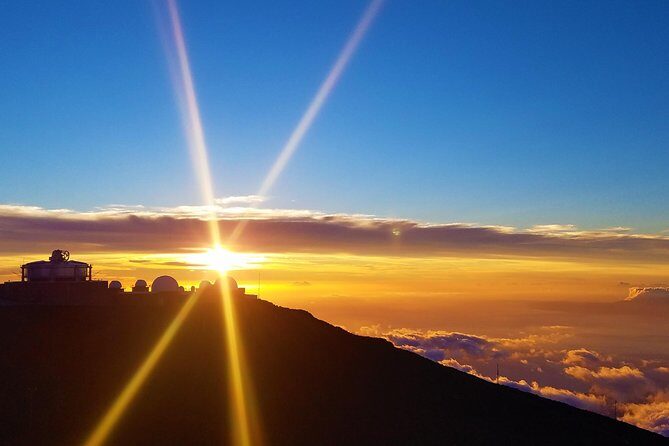
The Haleakalā Observatory stop is about two things: panoramic visibility and astronomy infrastructure. From the summit area, you can get 360-degree views of Maui and see other islands at a distance when conditions are good.
This area is home to advanced observatories used for science across the sky—studying the sun, stars, planets, and celestial events. One named facility at the site is Pan-STARRS, designed to scan for potentially hazardous asteroids and comets. The site also hosts solar telescopes and instruments focused on atmospheric and space surveillance.
Even if you don’t care about telescopes, the views can be the main attraction. Your best move is to treat this as your “wow stop” and stay long enough for the scenery to shift as the light changes.
Stop 4: Kula Botanical Garden—cooler air and easy wandering
After the summit zone, you’ll drop into a more relaxed pace at Kula Botanical Garden. This garden covers over 8 acres and was established in 1968 as a native Hawaiian plant reserve. Today it includes over 2,000 plant species, mixing native Hawaiian flora with exotic tropical plants and hybrids.
Why I like this stop for a Slingshot day: it’s the anti-stress counterpoint to mountain driving. You can take short walks on landscaped pathways, pause for photos, and enjoy features like water elements and a koi pond. The garden also includes a conservatory, an aviary, and nene geese.
Timing is about 45 minutes, which is usually enough to see the highlights without feeling like you need to “finish the whole garden.”
Stop 5: Ali’i Kula Lavender—rows of purple and sweeping valley views
Next up is Ali’i Kula Lavender, spread across 13.5 acres on the slopes of Haleakalā. It’s home to around 55,000 lavender plants and over 45 varieties, with guided tours that explain lavender farming and the farm’s history.
This stop also comes with big views. You can look out over Maui’s central valley and toward the West Maui Mountains while you stroll through the fields and gardens.
Plan for about 45 minutes here. If you time it right, this is a great “reset” stop between more hands-on places and any dining/shopping you want to tack on.
Stop 6: MauiWine—pineapple-forward flavors and classic estate style
At MauiWine, you’re mixing tasting energy with local agriculture. MauiWine has been producing wines since 1974, and it’s known for combining classic grape winemaking with a native Hawaiian pineapple angle.
There are estate-ground wines tied to Ulupalakua vineyards, plus tropical options focused on pineapple flavors. The setting includes historic grounds like King’s Cottage, and you’ll typically get a chance to explore and taste in a welcoming atmosphere.
This is a solid choice if you want something calm and “sit down for a while” after driving. The listed stop time is about 1 hour 30 minutes, which leaves room to slow down and enjoy the flavors rather than rushing.
Stop 7: Worcester Glassworks—hand-blown art you can watch happen
If you like crafts, Worcester Glassworks is worth the quick stop. It’s a hand-blown glass studio on the slopes of Haleakalā, with pieces known for vivid colors and shapes inspired by the Hawaiian environment and culture.
You’ll find functional items like vases and glasses, plus more artistic sculptures. Because the pieces are handcrafted, variations in color and form are part of the appeal.
One advantage for this kind of tour: you can often see the glassblowing process firsthand. Even a short visit can make the place feel more “alive” than a standard retail stop.
Timing is about 30 minutes.
Stop 8: Maui Tropical Plantation—tram tour and farm-to-table at the Mill House
Your final stop is Maui Tropical Plantation, a large estate that focuses on tropical crops. You can see cultivation and get explanations about crops such as coconuts, papayas, mangoes, and more.
A major feature is a tram tour that moves you through fields and helps you understand how farming works here. The grounds also include the Mill House, where you can enjoy farm-to-table dining using locally sourced ingredients.
This stop has extra activity options too, including zipline adventures, shopping at artisan boutiques, and cultural demonstrations. If you want a bit of variety beyond scenery, it gives you that.
Listed time is about 1 hour.
Who should book this (and who should rethink it)
This experience is a strong fit if you:
- Want freedom and a flexible pace rather than a guided bus day
- Like driving and want the road time to be part of the attraction
- Enjoy a “mix of Maui types” day: summit views plus upcountry gardens, lavender, wine, and crafts
- Are comfortable packing for shifting weather and temperature
You should rethink it if:
- You don’t like exposure. The Slingshot has no top, so sun and wind control your comfort level.
- Altitude affects you easily. The summit zone is high enough that you may feel symptoms above 10,000 feet.
- You want guaranteed, perfect weather. Cloud cover and rain can reduce visibility, and you’ll still be driving.
Also: drivers must be 21+ and hold a valid driver’s license, and passengers must be able to sit securely. There’s a refundable security deposit of either $750 or $1,500 at pickup, so have that ready.
Should you book the Haleakalā Slingshot tour from Lahaina?
If your idea of a great Maui day is driving, choosing your own pace, and hitting multiple major stops without the stress of group schedules, I’d book it. The value comes from the 24-hour Slingshot, the preloaded route, and the fact that you’re not limited to just one viewpoint—you get crater and observatory-style views, then gardens, lavender, wine, glasswork, and a plantation stop.
Make your decision based on comfort with two realities: weather and altitude. Bring strong sun protection and layers, plan for cold wind at height, and take summit time seriously if you’re prone to feeling dizzy.
If you’re excited by the idea of open-air volcano driving, this is one of the most fun ways to see Haleakalā on your own terms.
FAQ
What’s included with the Slingshot rental?
The tour includes 24-hour use of a Polaris Slingshot, helmets, and a self-guided tour route pre-programmed in the on-board navigation system.
Are park entrance fees included?
No. National Park entrance fees are $30.00 per vehicle and $30.00 per booking. Stop admissions are listed as not included at the Haleakalā Visitor Center, Haleakalā Crater, and Haleakalā Observatory.
Do I need a reservation for sunrise?
Sunrise reservations are not automatically included. Sunrise reservations (3am–7am) cost $1.00 per booking.
How long is the tour?
The experience runs for about 1 day. You also have the Slingshot for a full 24 hours, so you can follow the route at your own pace.
Where do I start and end?
The meeting point is Kaanapali, HI 96761, and the activity ends back at the meeting point.
What do I need to drive?
The driver must be 21+ and have a valid driver’s license from any country. Passengers of any age must be able to securely sit in the seat.
Can I cancel and get a refund?
Yes. Cancellation is free up to 24 hours in advance for a full refund. If you cancel less than 24 hours before the start time, the amount you paid is not refunded.